
Technical specifications
Introduction
Welcome to the technical specification document for HUME. HUME is a product designed to measure stress using wearables and artificial intelligence. This document aims to provide a concise technical overview of how HUME works, with a specific focus on security aspects and system architecture.
If you are looking for the HUME user manual, please refer to this website: HUME Manuals.
Mentech follows a structured development roadmap with accompanying monthly release notes to keep customers informed about recent developments.
The HUME development roadmap for 2023/2024 will be released in Q4 2023.
The monthly HUME release notes can be accessed here.
If you are missing a feature, you can always submit a request by email or phone. This request will then be included in our development roadmap.
Email for support & feature requests: support@mentechinnovation.eu
Overview of HUME
To achieve reliable real-time stress measurement, HUME has a multidisciplinary setup and advanced system architecture.
AWS Cloud Platform – The HUME platform runs on Amazon Web Services (AWS). This provides several advantages, such as dynamic scalability depending on the number of users. In addition, we benefit from the most recent security updates and the latest implementation techniques for our applications. Our servers and databases are located in Frankfurt, Germany. By storing our data in a specialized and encrypted manner, we guarantee the highest level of security for our users.
HUME App – The HUME app serves as the central application for HUME users. Through this app, users gain real-time access to data from one or more clients. They can look back up to one hour in time and stop measurements directly from the app.
HUB Application – The HUB application functions as a connector for data transmission between the Bluetooth SentiBLE or Movesense medical sensor and the cloud. Caregivers log in, select the correct client, and start a measurement. The data is visible in real time via both the smartphone application and the web dashboard.
Web Dashboard – The web dashboard is designed for detailed behavioral analysis and historical data insights. Users can, for example, compare two days to identify behavioral changes. This supports the planning of targeted interventions and the evaluation of their impact. An export function for reporting is also available.
Bluetooth Wearable – This category includes the SentiBLE and the Movesense Medical. The SentiBLE, developed by Mentech, measures skin conductance (EDA), heart rate, and movement. The Movesense Medical, a third-party wearable, functions as a smart sock and communicates via Bluetooth 5.1 with a smartphone, which then forwards the data to the HUME cloud.
SentiLTE – The SentiLTE, also developed by Mentech, measures skin conductance (EDA), heart rate, and movement. This smart sock-like wearable communicates directly with the HUME cloud via mobile internet, making it ideal for clients who do not always have a smartphone within reach.
Databases – HUME uses various databases. These databases are fully encrypted and backed up daily. Timestream databases securely store recent measurement data (during a session); after the session, the data is automatically transferred to Amazon S3. Amazon S3 is used for long-term storage of less active measurement data. A PostgreSQL database contains user data such as login credentials and HUME metadata. Measurement data is automatically deleted after two years.
Containerized AI – Data is analyzed in real time by our AI models. These models are isolated from the main platform and only process input and output data. They deliver a stress indication, which is visually represented as a traffic light.
HUME API – The HUME API follows the OpenAPI principle. All API endpoints are secured with an authorizer. After authentication, external applications can retrieve data from HUME, enabling integration with, for example, electronic client records.
Overview of HUME
To achieve reliable real-time stress measurement, HUME has a multidisciplinary setup and advanced system architecture.
AWS Cloud Platform – The HUME platform runs on Amazon Web Services (AWS). This provides several advantages, such as dynamic scalability depending on the number of users. In addition, we benefit from the most recent security updates and the latest implementation techniques for our applications. Our servers and databases are located in Frankfurt, Germany. By storing our data in a specialized and encrypted manner, we guarantee the highest level of security for our users.
HUME App – The HUME app serves as the central application for HUME users. Through this app, users gain real-time access to data from one or more clients. They can look back up to one hour in time and stop measurements directly from the app.
HUB Application – The HUB application functions as a connector for data transmission between the Bluetooth SentiBLE or Movesense medical sensor and the cloud. Caregivers log in, select the correct client, and start a measurement. The data is visible in real time via both the smartphone application and the web dashboard.
Web Dashboard – The web dashboard is designed for detailed behavioral analysis and historical data insights. Users can, for example, compare two days to identify behavioral changes. This supports the planning of targeted interventions and the evaluation of their impact. An export function for reporting is also available.
Bluetooth Wearable – This category includes the SentiBLE and the Movesense Medical. The SentiBLE, developed by Mentech, measures skin conductance (EDA), heart rate, and movement. The Movesense Medical, a third-party wearable, functions as a smart sock and communicates via Bluetooth 5.1 with a smartphone, which then forwards the data to the HUME cloud.
SentiLTE – The SentiLTE, also developed by Mentech, measures skin conductance (EDA), heart rate, and movement. This smart sock-like wearable communicates directly with the HUME cloud via mobile internet, making it ideal for clients who do not always have a smartphone within reach.
Databases – HUME uses various databases. These databases are fully encrypted and backed up daily. Timestream databases securely store recent measurement data (during a session); after the session, the data is automatically transferred to Amazon S3. Amazon S3 is used for long-term storage of less active measurement data. A PostgreSQL database contains user data such as login credentials and HUME metadata. Measurement data is automatically deleted after two years.
Containerized AI – Data is analyzed in real time by our AI models. These models are isolated from the main platform and only process input and output data. They deliver a stress indication, which is visually represented as a traffic light.
HUME API – The HUME API follows the OpenAPI principle. All API endpoints are secured with an authorizer. After authentication, external applications can retrieve data from HUME, enabling integration with, for example, electronic client records.
Wearables
HUME uses a range of wearables to measure stress in users. These wearables can be deployed in various combinations to achieve the most comfortable implementation for each user.
Wearable Name | Description | Visual |
|---|---|---|
SentiBLE
| The SentiSock V2 is an improved version of Mentech’s wearable device, introduced in 2022. Compared to V1, the V2 is smaller in size, has a longer battery life, and can also measure heart rate using PPG (Photoplethysmography). An additional advantage of the V2 is the ability to measure sock degradation. Moreover, this version has opted for a USB-C connection instead of the previous snap buttons. The SentiSock V2 also uses BLE 5.1 for wireless communication. | 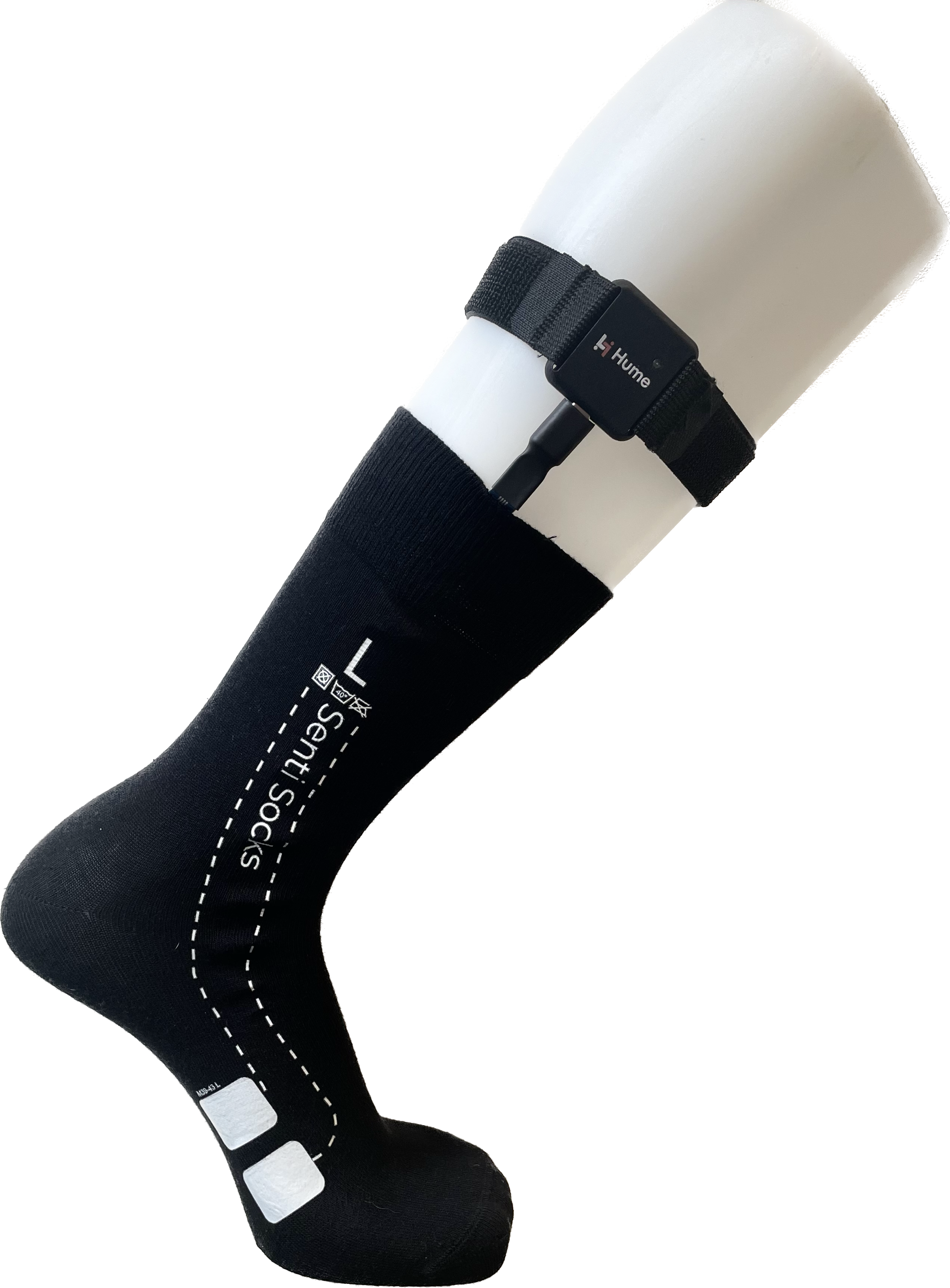 |
MoveSense medical HR+ | Movesense Medical is an MDR Class IIa certified sensor purchased by Mentech. This wearable specializes in measuring 1-channel ECG, heart rate, heart rate variability, and movement through a chest strap. This wearable is primarily used for monitoring heart rhythm, which in turn can be used to measure stress. This sensor also uses BLE 5.1 for wireless communication. | 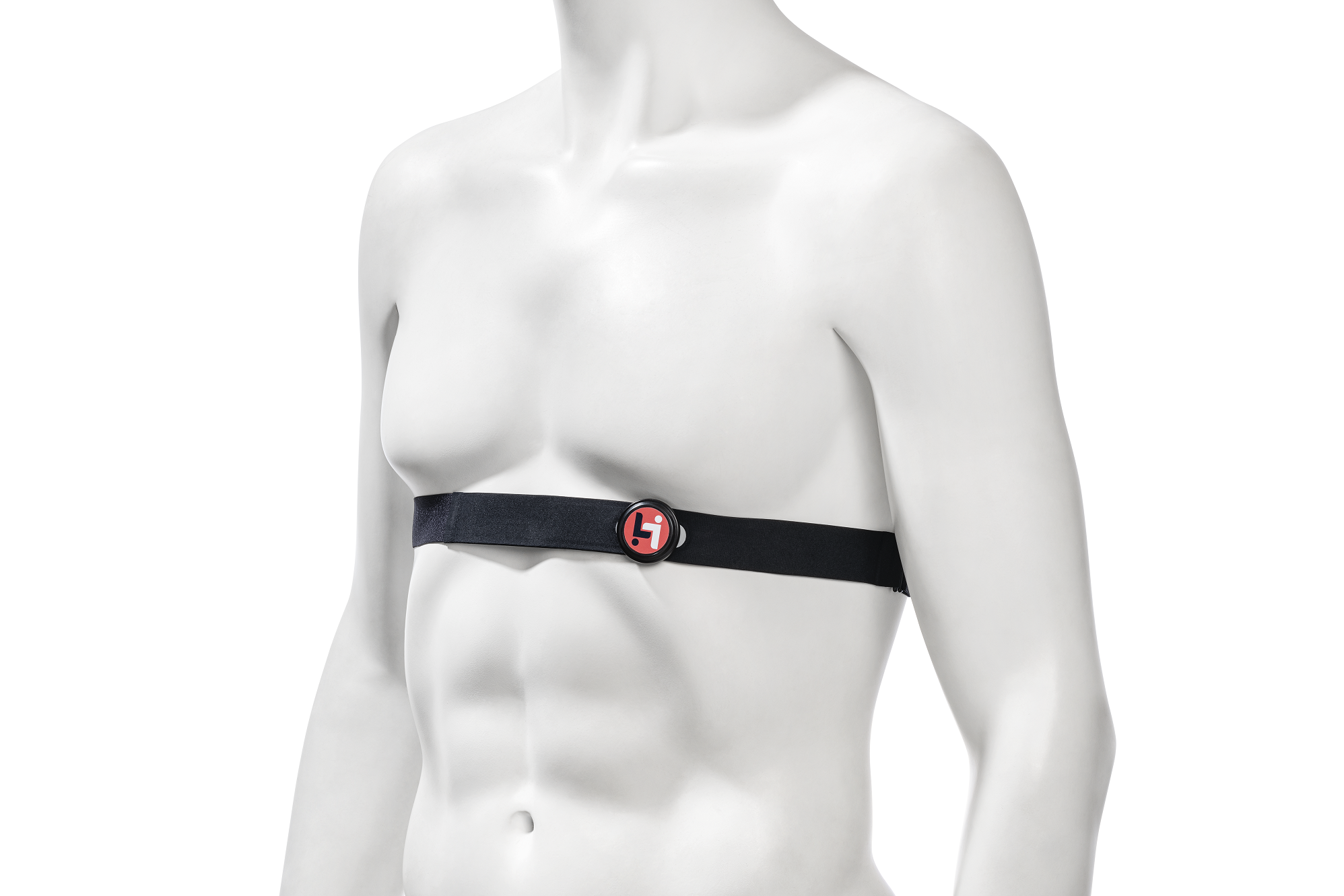 |
SentiLTE | The SentiLTE is an advanced variant of the Senti. In addition to the ability to connect via BLE 5.1 with a phone or other BLE wearables, this version features LTE connectivity. This allows the device to send data directly to the cloud, eliminating the need for a HUB phone. This offers greater flexibility and efficiency in collecting and transmitting data, making it ideal for situations where continuous cloud connectivity is required and a smartphone is not practical to keep close to the client. | Deze wearable is vanaf Q1 2024 beschikbaar. |
Applications
HUME Application
The HUME application serves as the primary interface for end-users of the HUME system. Through this application, users can view real-time data from one or more clients, access historical data up to one hour back, and stop active measurements.
HUB Application
The HUB application acts as an essential link between wearables such as the SentiBLE or Movesense Medical sensor and the HUME cloud. Caregivers can log in, select the appropriate client, and start measurements. The collected data is then visible in real-time via the application.
HUME Web Dashboard
The web dashboard provides a comprehensive overview of collected data and allows users to perform detailed behavioral analyses. The dashboard also has functionalities such as comparing data across different days and exporting reports.
Cloud infrastructuur
The HUME platform runs on Amazon Web Services (AWS), ensuring dynamic scalability, up-to-date security measures, and a robust infrastructure. Our servers and databases are strategically located in Frankfurt, Germany.
Security Measures
At HUME, we take data security extremely seriously. We have implemented a series of measures to ensure the integrity, confidentiality, and availability of your data.
HTTP/2 (TLS 1.3)
HTTP/2, based on the Transport Layer Security (TLS) 1.3 protocol, is the standard for secure communication on the web. By using HTTP/2 (TLS 1.3), we ensure that all data exchanged between HUME and end-users is encrypted and protected against interception. This provides strong protection against man-in-the-middle attacks and other forms of digital espionage.
MQTT
MQTT is a lightweight messaging protocol specifically designed for situations where a small code footprint and limited network bandwidth are required, such as in the case of IoT devices. At HUME, we use MQTT with full encryption for secure and efficient communication with sensors and other devices. This ensures fast and reliable data transfer with minimal delay.
Apache Kafka
Kafka is a distributed streaming platform capable of processing enormous amounts of data in real-time. At HUME, we use Kafka to ensure a smooth and reliable data flow between different components of our system. By utilizing Kafka’s built-in replication and partitioning mechanisms, we ensure high availability and scalability of our data streams. This means that even under high load or potential system failures, the data flow within HUME remains consistent and reliable.
User Management
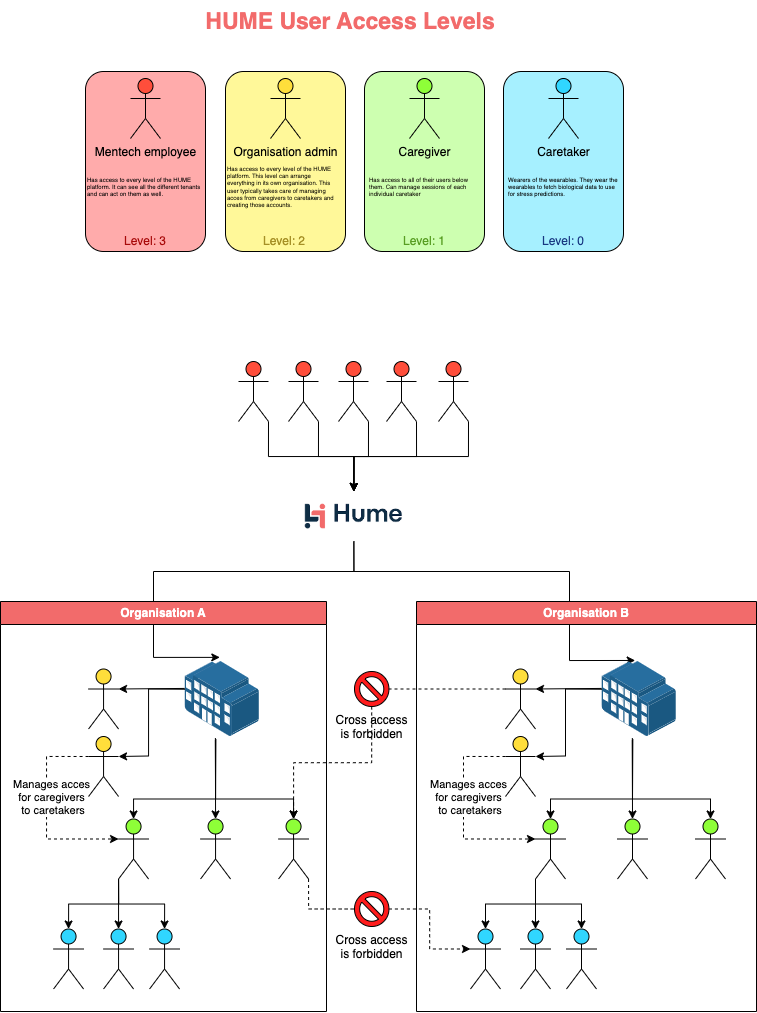
The HUME platform has different access levels to ensure that users only have access to the information and functionalities relevant to them. This contributes to both the security and user-friendliness of the system.
Mentech employee (Level 3): These are Mentech employees. They have the highest access rights and can view and manage virtually every layer of the HUME platform.
Organisation administrators (Level 2): These are administrators at the organization level. They can view specific details of their own organisation, such as caregivers’ access rights. They can also create new accounts for caregivers or manage existing accounts.
Caregivers (Level 1): Caregivers have access to their own dashboard and can view data from the clients to whom they are assigned.
Clients (Level 0): These are the end-users of HUME. They produce the data but do not have direct access to the HUME platform. Their data is used for analysis and predictions.
Organizational Separation
The figure below provides an overview of the authentication system. Each organisation (e.g., Organisation A and Organisation B) has its own separate space within the HUME system. This means that the data of one organisation is strictly separated from that of another.
For example, administrators of Organisation A can manage access for their caregivers, but they have no access to information or users of Organisation B.
Conversely, Organisation B has its own set of caregivers and clients, and the administrators of Organisation B can only manage these users.
The key point here is that there is no cross-access between organisations. This ensures privacy and data integrity for each organisation.
This structure ensures that each organisation can function independently within the HUME platform, while data and user rights remain strictly separated, contributing to both security and efficiency..
Communication Protocols
HUME utilises advanced communication protocols such as Bluetooth 5.1 for direct communication with wearables and LTE for direct cloud connectivity.
Databases
HUME uses various databases. These databases are fully encrypted and backed up daily. Timestream databases store encrypted recent measurement data (during a session); after the session, data is automatically moved to Amazon S3. Amazon S3 serves for long-term storage of less active measurement data. A PostgreSQL database contains user data such as login credentials and HUME metadata. Measurement data is automatically deleted after two years.
Timestream Databases
What it is: Timestream databases are specialised in storing time series data. This type of database is optimised for data that comes in sequentially and at time intervals.
How we use it: During a session, we store recent measurement data encrypted in Timestream databases. This ensures fast access and analysis while the session is active. After the session ends, this data is automatically moved to Amazon S3 for long-term storage.
Amazon S3
What it is: Amazon’s Simple Storage Service (S3) is a robust and scalable object storage system.
How we use it: After the session, measurement data from Timestream databases is moved to S3. S3 is used for long-term storage of less active measurement data. This means that the data is safely stored for later access and analysis but is not immediately needed for real-time processing.
PostgreSQL-databases
What it is: PostgreSQL is an open-source relational database system.
How we use it: We use PostgreSQL for storing static user data and usage statistics, and for HUME-specific metadata. This database ensures secure and organized storage of essential user information.
Both Amazon S3 and the PostgreSQL databases are fully encrypted and backed up daily, providing an extra layer of security. Additionally, all measurement data is automatically deleted after two years to ensure user privacy and comply with data retention guidelines.
Together, these storage solutions offer a layered and efficient approach to data management, with an emphasis on security, accessibility, and compliance.
OpenAPI
The HUME API is based on the OpenAPI principle, which allows external applications to access HUME data after authentication. This enables seamless and efficient integrations with other systems, such as electronic client records. The full OpenAPI specification can be consulted here. For access to this API, you can contact support@mentechinnovation.eu.
Platform Scalability
HUME’s architecture is designed with growth in mind. Thanks to our choice of Amazon Web Services (AWS), we can easily allocate or reduce resources based on current demand. This means that HUME can scale both vertically (adding more capacity to an existing server) and horizontally (adding additional servers), depending on the need.
Moreover, the use of services like Apache Kafka allows for processing enormous amounts of data in real-time, which is essential for scalability in data-intensive applications like ours.
HUME Performance
HUME strives to deliver fast and reliable performance at all times. We use advanced caching mechanisms and optimisation techniques to ensure that data can be retrieved and processed quickly.
Our use of Timestream databases for active sessions ensures quick access to recent data, which is crucial for real-time monitoring and analysis. On the other hand, the use of Amazon S3 for long-term storage provides a reliable solution for data that is not immediately needed but can be retrieved at any time.
Additionally, the HUME platform is optimised for low latency, resulting in immediate feedback and real-time responses, which is especially important in interactions with wearables and other IoT devices.
Combined, all these elements ensure that HUME consistently delivers high performance, whether processing a few data points or handling massive data streams during peak loads.
Artificial Intelligence
Overview of models in use
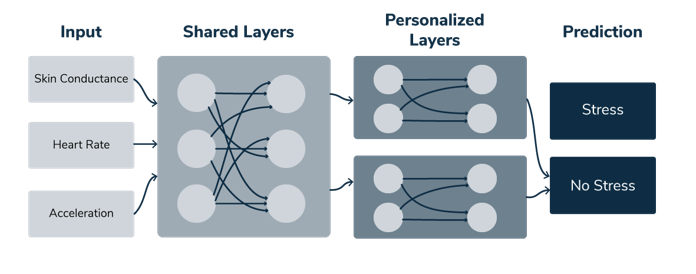
HUME uses advanced AI models to perform real-time analyses on collected data. These models are optimised for detecting stress indicators and other relevant health parameters. The results are then visually displayed for the user.
Component | Description | Current version | Released |
|---|---|---|---|
Arousal model EDA | AI model for real-time emotional arousal prediction based on electrodermal activity in real time. | v1.0.0 |
|
Arousal model HR | AI Model for real-time emotional arousal prediction based on heart rate varibilty in real time. | v1.0.0 |
|
HAR model | Detailed activity prediction to distinguish stress from physical or mental origin in real time. | v1.0.0 |
|
Combination algorithm | Combines Arousal EDA, Arousal HR and HAR to reduce signal dependability and increase accuracy. | v1.0.0 |
|
Diagnostics model | Uses historic data to determine stress levels over longer windows of data. | TBD | To be released |
Preconditions
Certification
The HUME system complies with strict quality and safety standards and is certified according to relevant industry standards. This guarantees the reliability and safety of the system for all users.
Compliant | Directive / standard | Purpose |
|---|---|---|
✅ | MDR 2017/745 | EU Medical device regulation, class 1 classification of device |
✅ | GDPR 2016/6791 | Protection and processing of personal data |
✅ | IEC 60601 | Norm for basic safety and essential performance of medical electrical systems |
✅ | IEC 62304 | Norm for medical device software development lifecycle. The set of processes, activities, and tasks described in this standard establishes a common framework for medical device software life cycle processes |
✅ | ISO 9001/13485 | Quality management system |
✅ | ISO 14971: 2012 | Specifies terminology, principles, and a process for risk management of medical devices, including software as a medical device |
✅ | IEC/TR 80001 | Application of risk management for IT-networks incorporating medical devices - Part 1: Roles, responsibilities, and activities |
✅ | NEN 7510 / ISO 27001 | Information Security Management System, specific for care |